


“Know your history.” A First Nations participant offered those words during a working session I was facilitating. He spoke about understanding what had happened before in order to understand the current moment: what the community had tried, what had worked, what hadn’t and what else had been happening along the way.
That observation has stayed with me. He was asking us to consider the context that had brought the community to this point. Before deciding where to go, we needed to understand how we had arrived.
George Santayana captured the warning in his 1905 book The Life of Reason: “Those who cannot remember the past are condemned to repeat it.”
I see the relevance in organizations all the time. We gather people to plan their future, often without exploring the history that shaped their present. What have we tried? What have we learned? What have we quietly edited out of the story?
It is a bit like being handed a novel with the first hundred pages missing and being asked to recommend the ending. You can certainly have an opinion. You may, however, be missing a few important plot developments.
We were there. But do we understand what happened?
When I recommend a historical scan at the beginning of a strategic planning process, there is sometimes a little pushback. We know what happened. We were there. Couldn’t we spend that time looking forward?
Fair enough. Most organizations have limited time, plenty to discuss and very little appetite for an activity that sounds suspiciously like homework.
But living through something and understanding it are different experiences. While events were unfolding, people were busy responding: keeping programs running, managing funding changes, welcoming new leaders and occasionally wondering what fresh adventure the inbox had prepared for them.
They were also experiencing different parts of the story:
- One team saw an exciting period of growth; another experienced months of unsustainable workloads.
- A newer leader inherited structures and expectations without knowing the circumstances that created them.
- Long-serving colleagues remembered what had been tried before, but hadn’t necessarily had an opportunity to share why it mattered.
People know what happened from where they stood. The useful work begins when we bring those perspectives together to understand the patterns, relationships and decisions that have shaped where we are today.
Getting the chapters in order
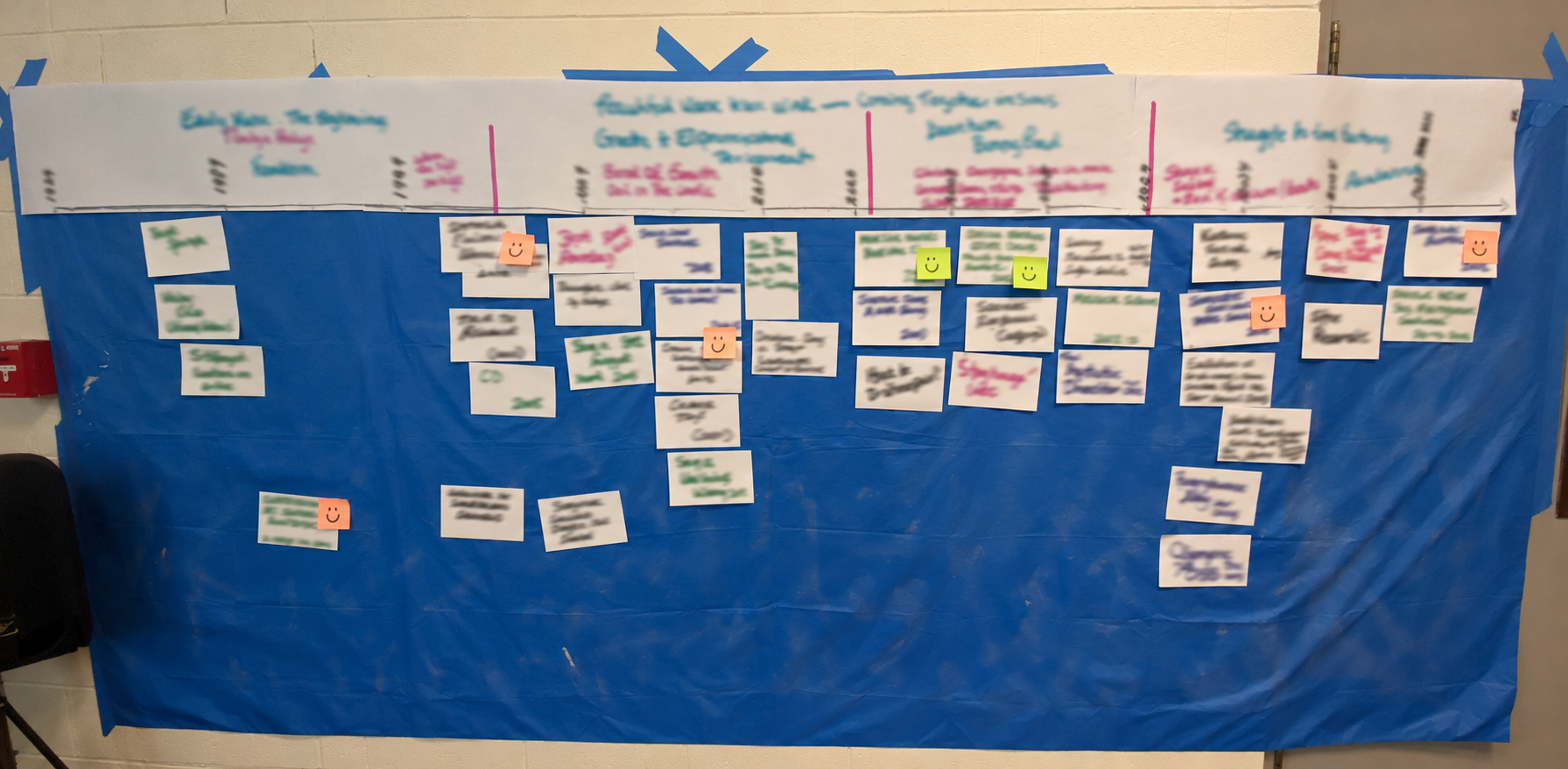
A historical scan starts with a timeline. We choose a period that matters to the group. It could be the last five, ten or twenty five years, or perhaps the time since a merger or another significant stretch of organizational life. (A colleague talks of a First Nations community choosing a 400 year timeline!)
From there, we work through a few layers:
- What happened? We populate the timeline with accomplishments, new programs, leadership transitions, difficult decisions, successes and setbacks.
- What else was going on? We include the external events that influenced the organization: elections, policy changes, economic pressures and, inevitably, COVID.
- How did people experience it? We identify the high points and difficult periods, making room for different experiences of the same event.
- Where did the story shift? We look for connections, turning points and decisions whose consequences became apparent much later.
- What would we call these phases? We name them as if they were chapters in a book and then eventually step back and consider a title for the whole book.
Sometimes we mark the highs and lows with happy and sad faces. Sophisticated organizational insight, surprisingly modest art supplies.
The chapter names people choose can reveal a great deal about what they have been carrying. By then, we are usually having a much richer conversation than a simple review of dates and accomplishments.
The “oh, now I get it” moment
This is the part I love.
I cannot tell you how often someone looks at the timeline and says, “Now I understand why it was like that.” Sometimes they lived through the entire period. They simply hadn’t had an opportunity to step back far enough to see it.
In one process, a six-year look back gave a COO a much fuller understanding of the organization she had joined. She could see the events leading up to her arrival and put her own experience into a larger context. She had entered partway through the book; now she could read the earlier chapters.
Another organization could see how much its experience during COVID had shaped its current circumstances:
- Its profile grew, bringing greater visibility and demand.
- Temporary funding supported additional programs, and people responded to an extraordinary amount of activity.
- A few years later, it was having to scale back, while still carrying expectations shaped by that period of growth.
Put those events together, and the present looks different. The group can see the relationship between temporary funding, expanded activity and the pressures it is managing now.
The same thing happens when an organization looks at its history of leadership changes. What people have been describing as chaos begins to make more sense when they see how often direction, expectations and priorities have shifted.
There can be real relief in that recognition. Perhaps we weren’t terrible at this after all. Perhaps we were managing rather a lot.
With that understanding, the conversation can move toward what would help now.
Same chapter, different experiences
A historical scan can be profoundly honouring for people who have been around for a long time. It creates space to recognize what they contributed, what they endured and what it took to keep things moving.
It also allows people to hear experiences they may never have understood. Someone’s proudest accomplishment may have coincided with someone else’s most difficult year. Both experiences belong in the conversation.
The facilitator’s work is to help the group explore those differences, notice patterns and consider what shaped them. That takes some care. We need enough curiosity to hear an unfamiliar account, especially when we thought we already knew the story.
For newer colleagues, this can be an excellent onboarding experience. They begin to understand:
- Why a certain accomplishment still carries so much pride.
- Why a seemingly straightforward suggestion creates unease.
- Why people keep referring to a decision made years ago.
- What their colleagues have navigated to bring the organization to this point.
Suddenly, some of the organizational footnotes become legible.
SharePoint does not remember everything
One thing I have come to appreciate in this work is how much organizational history lives in people’s heads.
A large layoff or a wave of retirements can take decades of knowledge out the door. The documents may remain. The understanding behind them is harder to recover.
A file can tell you what was approved. It may be less helpful on why the alternatives were rejected, what had already been tried or which relationships made the eventual decision possible.
Somewhere, there may be a document called “FINAL_strategy_REVISED_v7.” It is unlikely to explain all of that.
Making time to share that history helps preserve the context behind the decisions, along with the lessons people learned along the way. It also gives the organization an opportunity to examine its familiar stories.
What have we remembered clearly? What have we simplified? Whose experience has been missing from the telling?
Before we turn the page
As the year winds down, it is tempting to move quickly into next year’s priorities. There are plans to finish, goals to set and calendars already filling up. Before we turn the page, there is value in pausing together and asking:
- What happened this year that changed us?
- What are we still responding to from years before?
- What do we understand better now?
- What do we need to remember when we make our next decisions?
You can explore those questions as an individual, a team or an entire organization. A little distance can help you recognize accomplishments, understand difficulties and see choices that were harder to spot while you were busy living through them.
The next chapter deserves some thought. So do the ones that got you here.
If you’re curious about our process or how we can help your team make sense of the story so far, I’d love to hear from you.

Robin has more than twenty-five years of experience as an effective leader and strategic thinker. She helps organizations have better conversations that help them work together more effectively.
Read full BioParsons Dialogue is based in Calgary, Canada, serving clients across North America. We design and facilitate strategic processes that help teams collaborate with clarity and confidence.




Tap into your team’s problem solving potential
Explore our services
Parsons Facilitation is based in Calgary, Canada, serving clients across North America. We design and facilitate strategic processes that help teams collaborate with clarity and confidence.
Privacy Policy